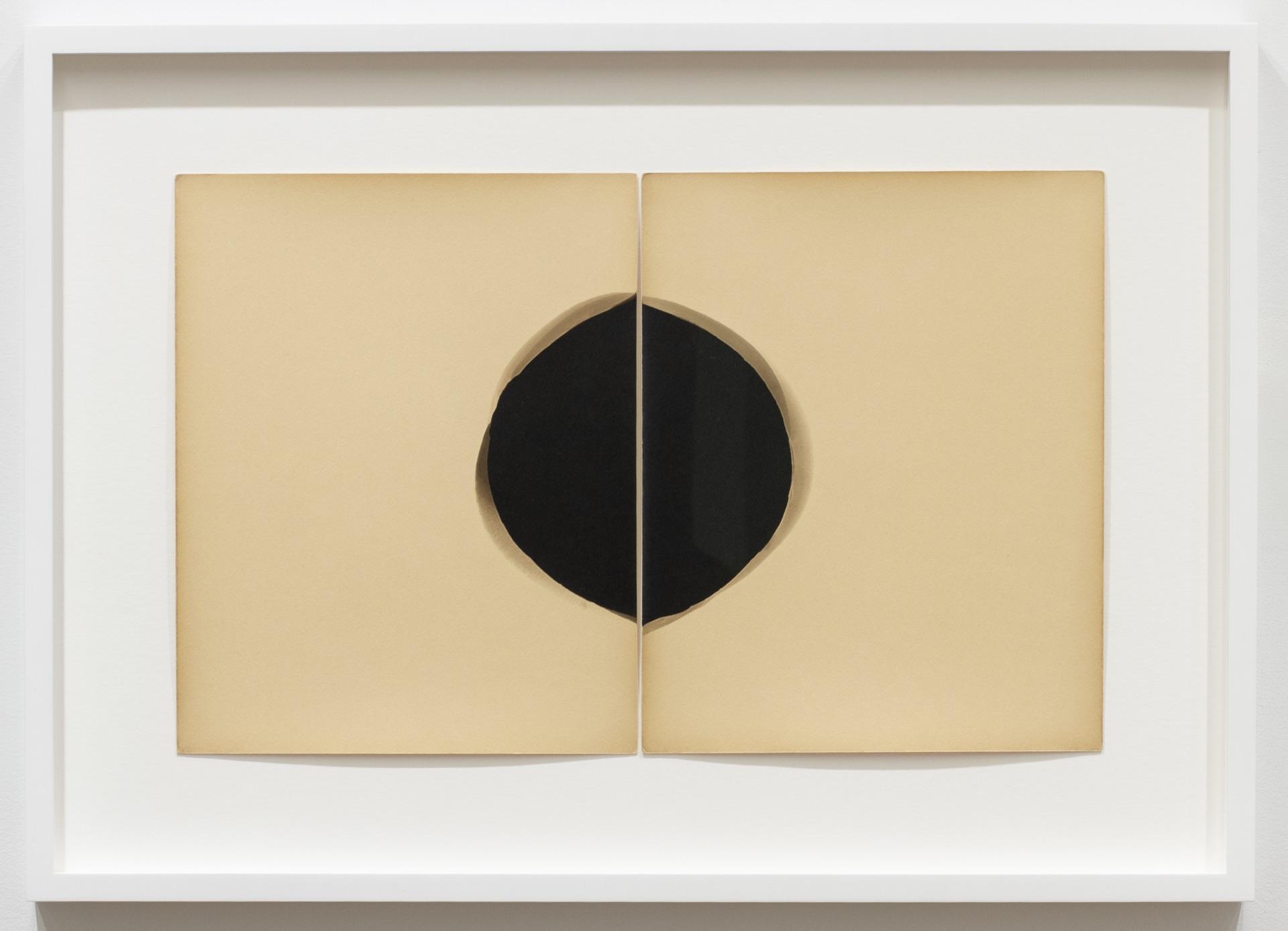
Most of what hangs at an art fair asks you to look at it. A few things ask you to notice how you are looking. At Art Basel Miami Beach, from December 4 to 6, 2026, the clearest example is not a painting and not a screen. It is a portfolio of prints. Cristea Roberts Gallery of London brings Portafolio Inducción Cromática a doble frecuencia, the complete set of ten lithographs by Carlos Cruz-Diez, as one of the 26 Kabinett presentations set inside exhibitors' booths. According to Art Basel, the lithographs "use overlapping black grids and five printed colors to generate hues not physically present on the paper."
Read that sentence twice. It is the whole of Cruz-Diez's argument in one line, and it is a stranger claim than it sounds.
Colour as an event
Cruz-Diez, born in Caracas in 1923 and based in Paris from 1960 until his death in 2019, spent six decades on a single proposition: that colour is not a property of things but something that happens. His foundation describes it as "an autonomous and evolutive reality" revealed by the viewer's senses. PAMM, in its writing on his work, calls it a "chromatic event" occurring in the present, free of preconceived meanings.
He built that proposition through eight lines of research, from the Physichromies he began showing in Caracas in 1960, frames of coloured strips whose hues change as you walk past (the name merges "physical" and "chromatism," as Tate Papers explains), to the Chromosaturation rooms that flood the body in red, green and blue. The Induction Chromatique, begun in 1963, is the most economical of them. His studio ties it to the after-image, the ghost colour the retina produces after staring at a strong one. In ordinary life that happens in two steps: you look, you look away, the complement appears. Cruz-Diez's grids make it happen at once. Thin black lines cross bands of colour, and in the gaps your eye supplies a colour that no one printed.
That is what Miami will be shown: five inks on paper and a viewer who sees more than five.
Why it belongs in Miami this year
The timing is not accidental. Art Basel points out that the portfolio follows the recent presentation of Cruz-Diez at the Pérez Art Museum Miami, where Carlos Cruz-Diez: Chromosaturation, conceived in 1965 and acquired for the collection in 2020, ran again from October 2, 2025, in its second installation at the museum. In New York, the Institute for Studies on Latin American Art gave him a research exhibition this spring, Carlos Cruz-Diez: Color at Stake, in its Tribeca space. And the same institute is on the fair floor this December with Zero 10's history of early computer art in Latin America, ARTE Y CIBERNÉTICA.
Put those together and a thesis appears that Art Basel does not quite state. In a year when the fair's digital sector is about generative screens and robots, the most rigorous work on perception in the building may be a set of lithographs by a Venezuelan who started before any of it. Cruz-Diez was making images that only exist in the viewer's head decades before anyone called that "interactive." He did it with cardboard, ink and lines.
What a print can carry, and what it cannot
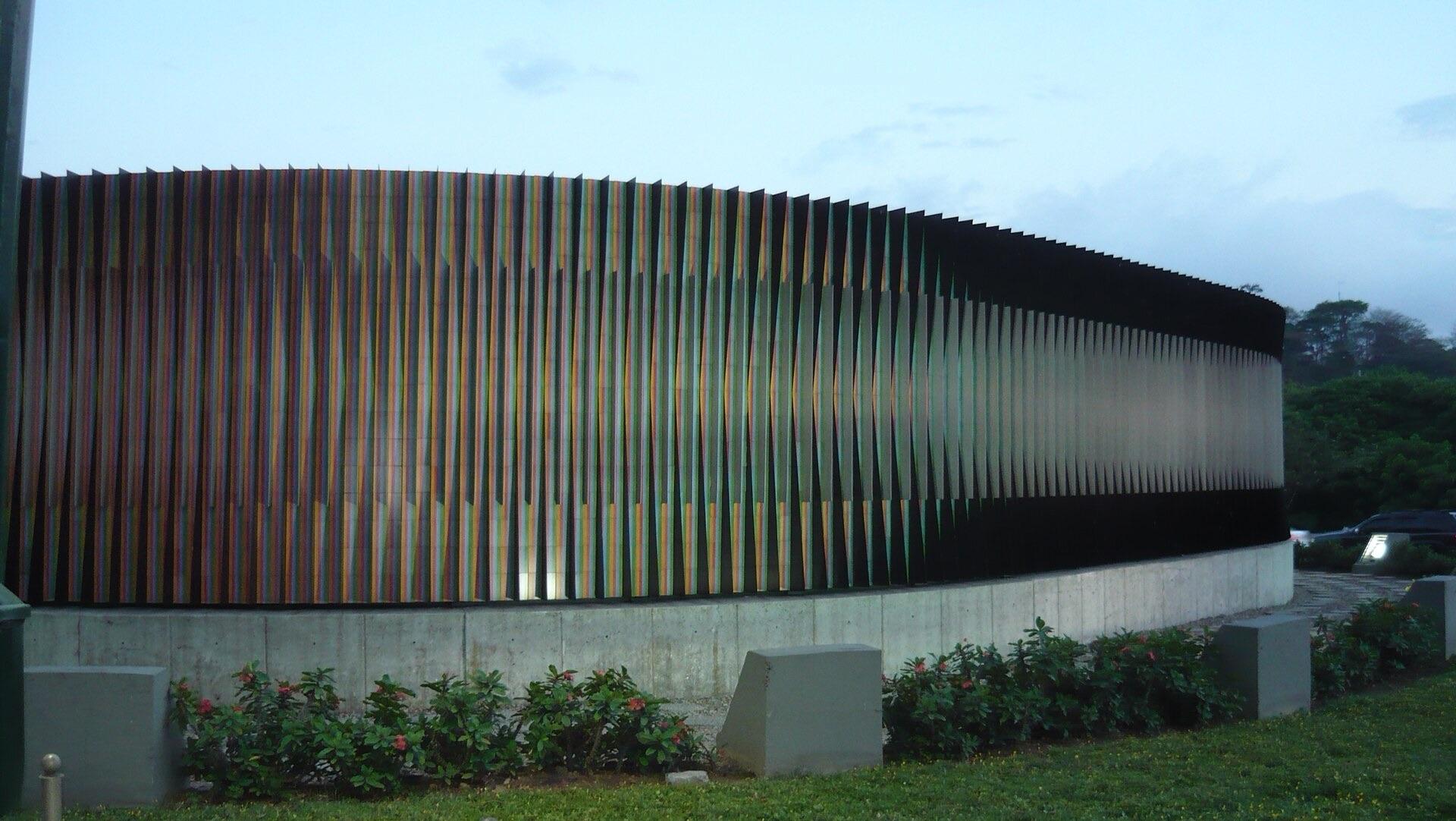
Here is where we would push back, gently, on the presentation. Cruz-Diez's best work is physical and mobile. The Physichromie in our photograph, in Plaza Venezuela, Caracas, is a wall of vertical blades: walk along it and the colours shift from warm to cool, appear and drain away. The work is the walk. A Chromosaturation room is the body inside the colour. A lithograph on a booth wall is the opposite situation, a flat sheet seen from one distance, under convention-centre light, between conversations.
The Induction Chromatique is the one strand of his research that survives that reduction, which is presumably why the prints exist at all. The effect does not need you to move. It needs you to stand still and keep looking, longer than a fair encourages. That is the test: whether visitors give the sheets the thirty seconds the after-image needs, or read them as handsome geometric decor in five colours and move on.
There is also the question of the edition. Art Basel dates the portfolio to 2012. Auction records for the complete set, published by Polígrafa in Barcelona in an edition of 40, give 2013, as listed by Christie's and Phillips. It is a small point, and the kind a buyer should settle with the gallery. The larger point is that this is a late, editioned work, produced when Cruz-Diez was nearly ninety, not a document of the heroic years. Its value is as a demonstration, not as a relic.
The lesson worth the detour
None of that makes it less worth seeing. On a floor organised, this year, to make collectors walk further, a Kabinett of prints is easy to pass. We would stop. Cruz-Diez's portfolio is a lesson in how little a work needs to produce an experience: lines, five inks and attention. Everything else in the hall, from the robots to the bronzes, is trying to do the same thing with more.
It is also, plainly, the most accessible way into a major artist that the fair will offer. Not because the price is low, but because the effect is complete in a single sheet. The colour you will see is not on the paper. It is the best argument in Miami for looking slowly.
Fair dates, the Kabinett count and the description of the Cruz-Diez portfolio at Cristea Roberts Gallery, including the quote on the grids and five colours, from Art Basel's exhibitor announcement of September 29, 2026, and its press release. Colour as an evolving reality and the Induction Chromatique from the Cruz-Diez studio; the Physichromie name and first showing per Tate Papers. Chromosaturation at PAMM, its dates, acquisition and the "chromatic event" per PAMM; the ISLAA exhibition Color at Stake per ISLAA. The 2013 date, the Polígrafa edition and its size per Christie's and Phillips. Photograph by Carlos E. Pérez S.L., CC BY-SA 2.0, via Wikimedia Commons. This is desk coverage ahead of the fair.