Few artists at Untitled Art this December, December 2 to 6 on the beach at Ocean Drive and 12th Street, arrive with a year like the one Sandra Vásquez de la Horra has just had. The fair's own announcement singles her out among the artists whose work is "shaping contemporary art's most significant institutional and international conversations," presented by Galeria SENDA of Barcelona. That sentence undersells it.
In the twelve months before Miami, her travelling survey The Awake Volcanoes, organised by the Denver Art Museum and curated by Raphael Fonseca, closed its run at the Institute of Contemporary Art, Los Angeles on March 1, 2026, her first solo exhibition in the United States. Haus der Kunst in Munich opened Soy Energía, her first institutional survey in Europe, curated by Jana Baumann and Marlene Mützel, from November 14, 2025 to May 17, 2026. In May, Tanya Bonakdar Gallery announced it now represents her, and her first show there, Reading the Waves, ran in New York from September 10 to October 29. Through all of it SENDA, the gallery that brought her to ARCOmadrid in March and paired her with the Catalan surrealist Joan Ponç in Barcelona this spring, has stayed in the picture.
Drawings that are also bodies
Vásquez de la Horra was born in Viña del Mar in 1967 and grew up under Pinochet's seventeen-year military regime, the Venice Biennale noted when Cecilia Alemani included her in The Milk of Dreams in 2022. She left for Germany in the 1990s, studied at the Kunstakademie Düsseldorf and then at the Kunsthochschule für Medien in Cologne, and lives in Berlin.
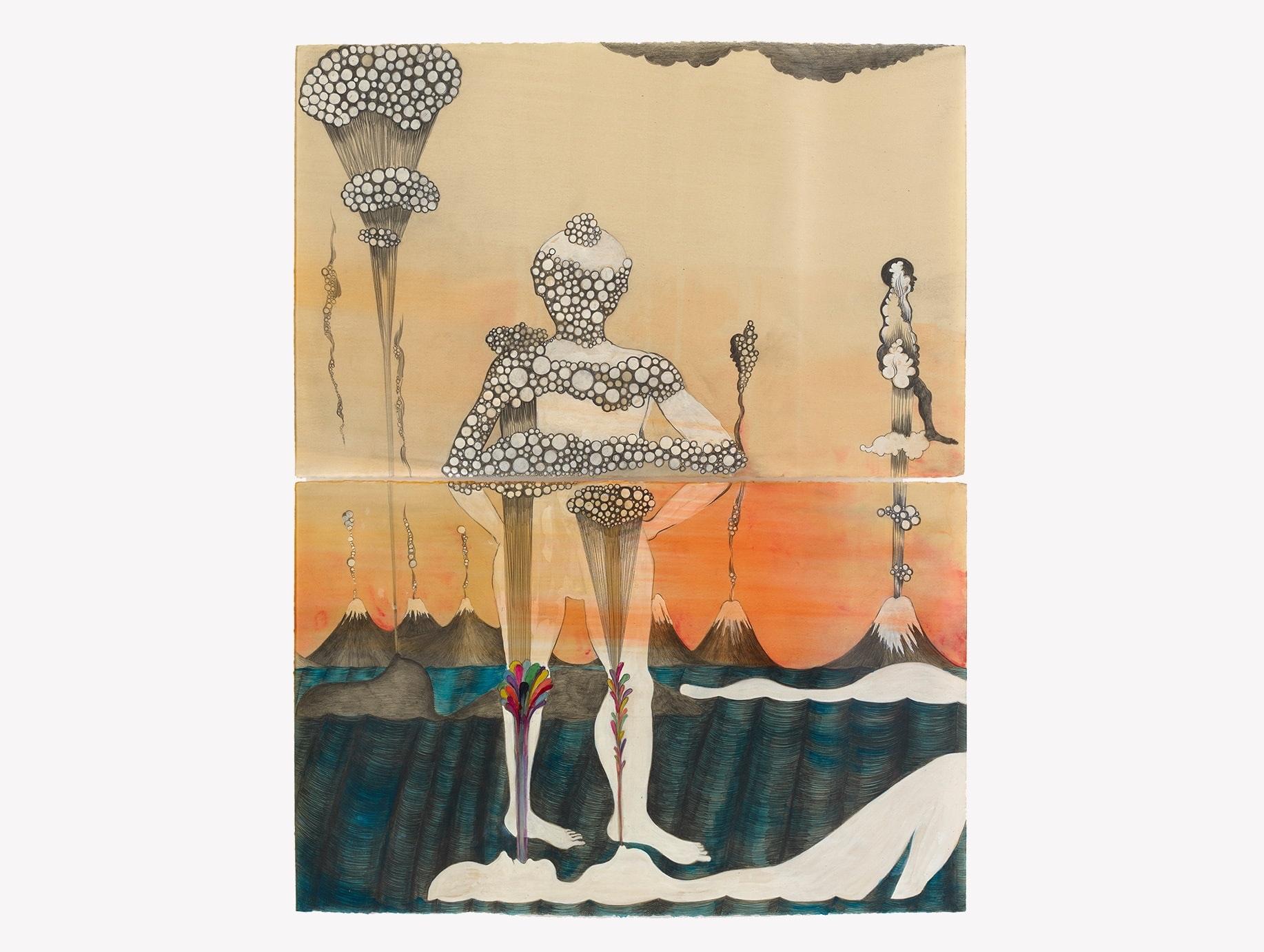
Her medium is drawing, and her signature is what happens after the drawing. She dips the finished sheets in molten beeswax, which the Biennale described as giving them a religious connotation and "a layer of vulnerability." The wax yellows the paper, softens the graphite and gives each sheet the slightly translucent surface of skin. On that surface she draws women who are also landscapes: bodies that erupt, mountains with feet, figures whose heads dissolve into clouds of cells. In El despertar de un volcán (2019), above, a figure built from bubbles stands knee-deep in a striped sea while a range of small volcanoes smoulders behind her and plumes rise from her legs like geysers. It is funny, unsettling and precise at once, which is the register she does best.
Critics have been consistent about where the power lies. Wyatt Coday, reviewing the ICA LA presentation for Artillery in March, called her drawings "precise renderings of the human body that also drip with wet, effusive psychic energy," and the show "a stimulating and necessary encounter." Tara Anne Dalbow, in Hyperallergic, argued that she makes visible, "without didacticism," the connection between the exploitation of the natural world and the subordination of women. John Yau, years earlier in the same publication, placed her figures in a domain that is fairy tale, horror story and dream at once.
The case against consensus
That consistency is the problem worth naming. An artist whose work depends on strangeness, on the drawing that should not be quite this erotic or quite this sacred, is at risk precisely when every institution agrees on what she means. The wall texts now converge on one reading: the body as landscape, the feminine as volcanic force, the Andes as cosmology. All of it is there in the work. None of it explains why a woman whose legs are fountains is still disturbing on the fifth viewing. The danger of a year like this one is that the volcano becomes a logo.
The second risk is format. In Venice, she showed the drawings inside a house-like wooden structure of her own design, because the work asks for closeness and a domestic scale. The accordion-folded sheets that have entered her recent work push in the same direction, pulling figures into space. A fair booth is the least intimate room in the art world. SENDA's presentation will be judged on whether it builds that intimacy back, or hangs the sheets as the best-known product of a newly famous name.
What the gallery map says
The business side of this year is worth reading as closely as the drawings. A move to Tanya Bonakdar, a gallery with spaces in New York and Los Angeles and a programme built around museum-level artists, is the kind of change that usually reorganises an artist's market: who gets the major works, which collectors are offered first, which museums are approached. It is notable, then, that the first Miami appearance after that announcement is not at Art Basel Miami Beach with the new gallery but at a satellite fair with the European dealer who carried her before the institutions did.
Read generously, that is loyalty and good sense: SENDA keeps a role in Europe and in the Spanish-speaking market, and Untitled gets an artist with real institutional weight. Read as a market signal, it suggests that the next twelve months of her career will be split between two galleries with different audiences, and that the most consequential decision is not which fair she appears at but which drawings each dealer gets. Collectors who have followed her since the Barcelona years should look closely at what SENDA brings this week. It may be the last time the work is priced for the audience that found it first.
What to take from it
Vásquez de la Horra is the right kind of artist for Untitled to put at the centre of its fifteenth edition, and the fair is right to claim her. The test in December is not whether the drawings are good. They are. It is whether, in a week that rewards the legible, they can still look like something nobody has explained yet. For context on how the satellite fairs fit into the week, see our guide to how Miami Art Week works.
Fair dates, location and the presentation by Galeria SENDA from Untitled Art's exhibitor announcement (September 2, 2026). The Awake Volcanoes: organiser, curators, dates and first US solo from ICA LA. Soy Energía dates and curators from Haus der Kunst. Representation and Reading the Waves from Tanya Bonakdar Gallery. ARCOmadrid and the Joan Ponç exhibition from Galeria SENDA. Biography, the wax technique, the 2022 Biennale and its wooden structure from La Biennale di Venezia. Quotes as reported by Wyatt Coday in Artillery (March 11, 2026) and Tara Anne Dalbow in Hyperallergic (January 6, 2026); John Yau's reading from Hyperallergic. Press image © and courtesy of the artist, photo © Eric Tschernow, via ICA LA. This is desk coverage.